
I was only in Sarajevo for two days, and it was not enough time! There are so many things to do in Sarajevo, from visiting its Ottoman-era mosques to walking along the Miljacka Canyon (just outside of the city centre!).
Sarajevo has an incredibly sad recent history. I visited the Museum of Crimes Against Humanity and Genocide and learned that it was under siege for four years (the longest any European capital has been attacked for) – and it only ended 30 years ago.
But the Sarajevo I experienced seems to be rising from the ashes. It was this Sarajevo I fell in love with; the mishmash of architectural styles, the chilled out cafes spilling onto the street, the looming hills which are explorable just a short walk from the centre.
It’s a complex city, but I like complex – and Sarajevo honestly has turned into one of my favourite cities in Europe.
So, let’s dig into all the best places to visit in Sarajevo that I discovered during my two days there!
About Sarajevo
While people already lived in the valley where Sarajevo is now located, the city as it is now known was founded in 1462 by the Ottomans – in particular, Isa-Beg Isaković. Baščaršija was the original centre. It was Ottoman for over 400 years, which explains how it is majority Muslim to this day.
But, when the Ottoman Empire crumbled, the Austro-Hungarians annexed Bosnia; they administered it from 1878 and formally annexed it from 1908. This set the stage for the start of World War One, when Archduke Franz Ferdinand was assassinated in the city, which caused a ripple effect which culminated in the beginning of the war.
Post WW1, Bosnia and Herzegovina joined Yugoslavia, and the peak of this era was the 1984 Winter Olympics. But just eight years later, the city was under siege. At four years, it was the longest siege of a European capital in modern history, and there were around 11,000 deaths including around 1,500 child fatalities.
After the siege ended, Bosnia and Herzegovina became independent and worked out a system where a separate part of the country (which Sarajevo borders) became the Republic of Srpska, was majority Orthodox and managed their own affairs.
Today, Sarajevo is still recovering – the effects of war, and the mass migration that follows it – take decades to get over, but from conversations with my partner, it seems to have changed a lot in the last 10 years since he was there. I have high hopes for it in the future!
Things to Do in Sarajevo
Free walking tour of the city
The first thing I attempted to do (as I do in most cities!) was a free walking tour. Spirit Tours were recommended by my hotel.
When I arrived, the guide was there, but he told me it would only run with 2+ people – and sadly, nobody else turned up. He gave me a few recommendations instead.
If you are visiting with at least one other person, it will go ahead – or you could try your luck if visiting solo, but you may have the same experience as me!
From a quick Google, there seem to be other walking tours in Sarajevo too, but I didn’t try any of these.
Sarajevo Cable Car
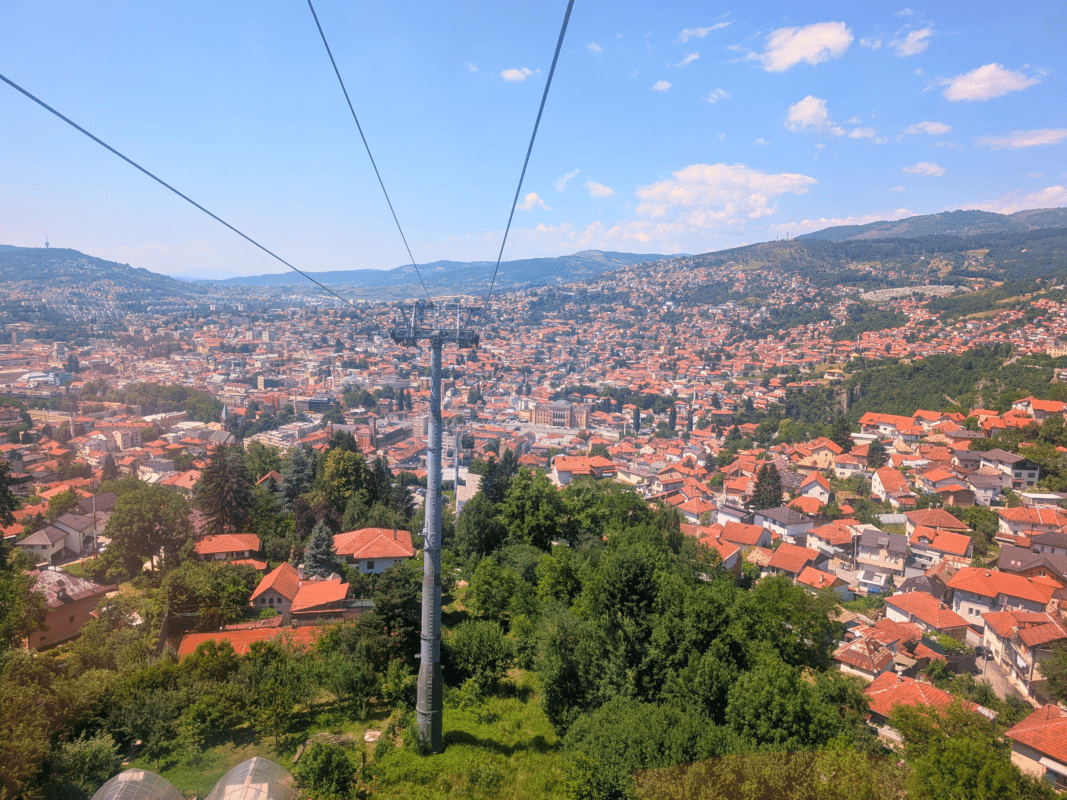
Whenever I visit a new city, I always try to make a habit of finding the best view first. So, when I learned that Sarajevo has a cable car, I made a beeline for it!
The Sarajevo Cable Car leads from the city centre to Trebević Mountain, where the Olympic Bobsleigh Track was located. As I ascended, I looked at all the Sarajevo attractions on my list – the Cathedral of the Sacred Heart, Sarajevo City Hall and the Dariva Path – and took in the mountains on all side (which, on a sombre note, made it possible to siege the city).
At the top station, there’s a cafe and free toilets, and lots of hiking trails along the hillside. The most popular leads to the bobsleigh track – more on that below.
There was a cable car in Sarajevo from 1959 until the war; I spotted one of the older cabins on display at the top station. It was damaged in the war, and a new cable car was created, which opened in 2018. My partner was shocked when I told him I was travelling in a cable car, as when he visited in 2015 he had to take a taxi up to the bobsleigh track!
Olympic Bobsleigh Track
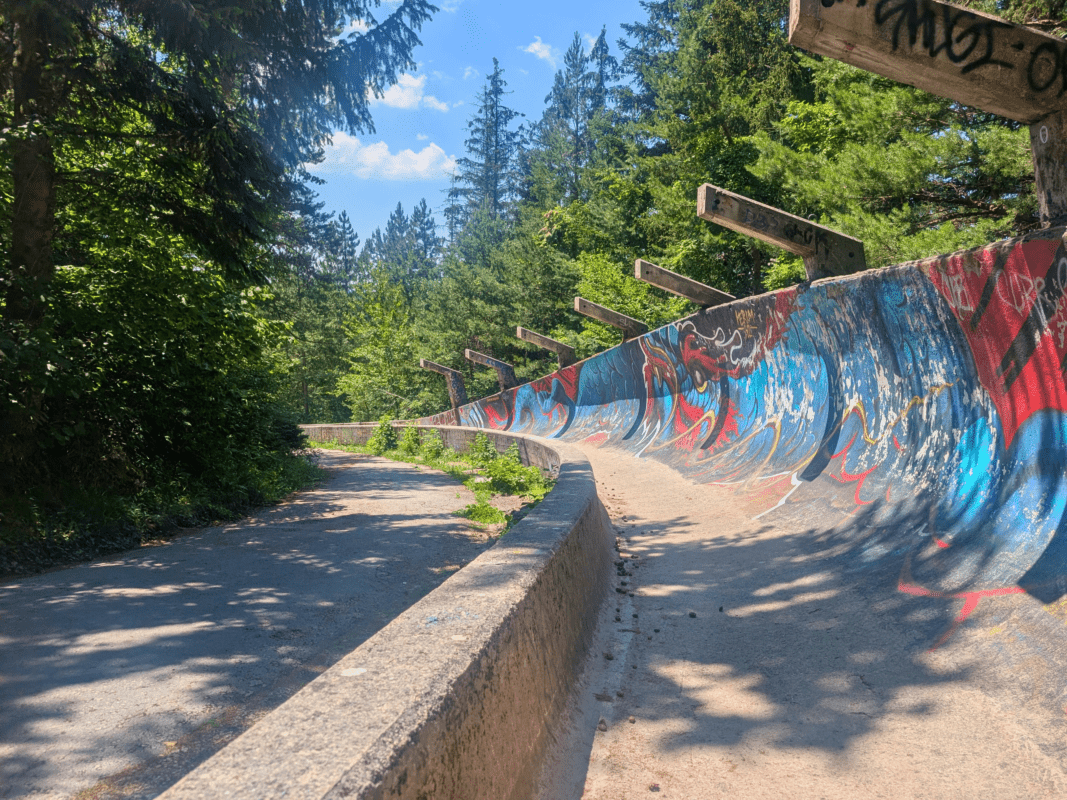
Sarajevo was the host city of the 1984 Winter Olympics. At the time, the city was thriving. While Yugoslavia wasn’t a completely free society, their form of Communism was more liberal than the Eastern Bloc and USSR, and they enjoyed cordial relations with the west.
This Bobsleigh Track was built for the Winter Olympics. It was 35 degrees (even up in the hills!) when I visited, so I couldn’t quite imagine it being cold enough for snowsports!
After the high of the Winter Olympics, nobody would have thought that eight years later, the city would have been under siege. But, during the Siege of Sarajevo, this was a site occupied by Serb forces. From here, they looked down onto the city, and perhaps even shelled it.
Since the war, the Bobsleigh Track has become bedecked with graffiti – I read that it’s one of the longest uninterrupted stretches of graffiti in the world. I walked down it for around 20 minutes, and then back the other direction.
Baščaršija (Old Bazaar)
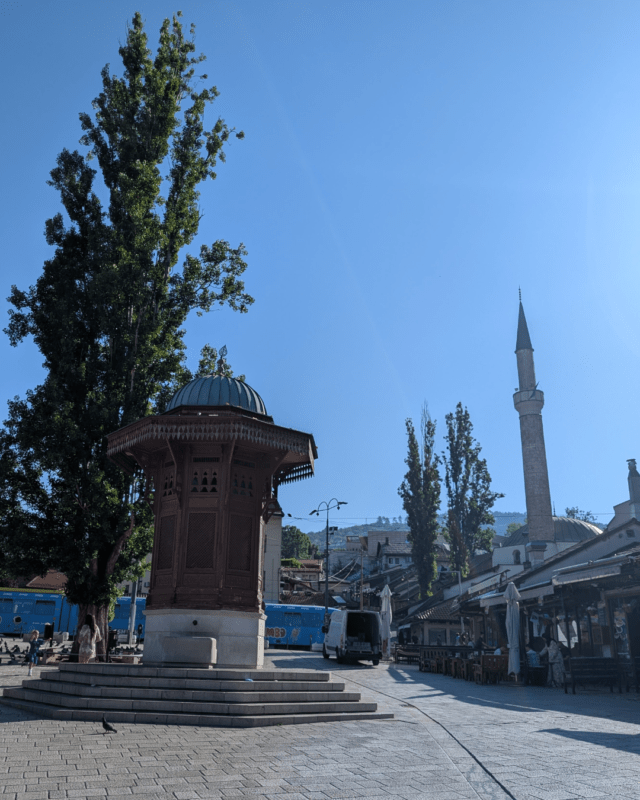
I was lucky to be staying right by the Baščaršija (Old Bazaar). Here is the centre of the Ottoman old town, which was founded in 1462. When I first arrived in this part of the city, I felt like I’d stepped back in time.
In the heart of the Old Bazaar, low buildings surround a city square. Here sits the Sebilj fountain, which to this day serves up fresh drinking water pumped from the nearby mountains. I filled my bottle from here – the water from it was so cold and crisp!
Legend has it that if you drink from the Sebilj fountain, you’ll return to Sarajevo, so I made sure I had two bottles worth (that means two more trips, right?).
Leading on from the main square, you’ll find streets that are named after their original trade, such as “metalwork street”. Copper was very important to Ottoman Bosnia, as coffee cups and kettles are made from the material! Nowadays, these streets are lined with shops and cafes.
I loved Fabrika for (non-traditional) coffee and Caffe Bar Andar for Bosnian coffee!
Gazi Husrev-beg Mosque
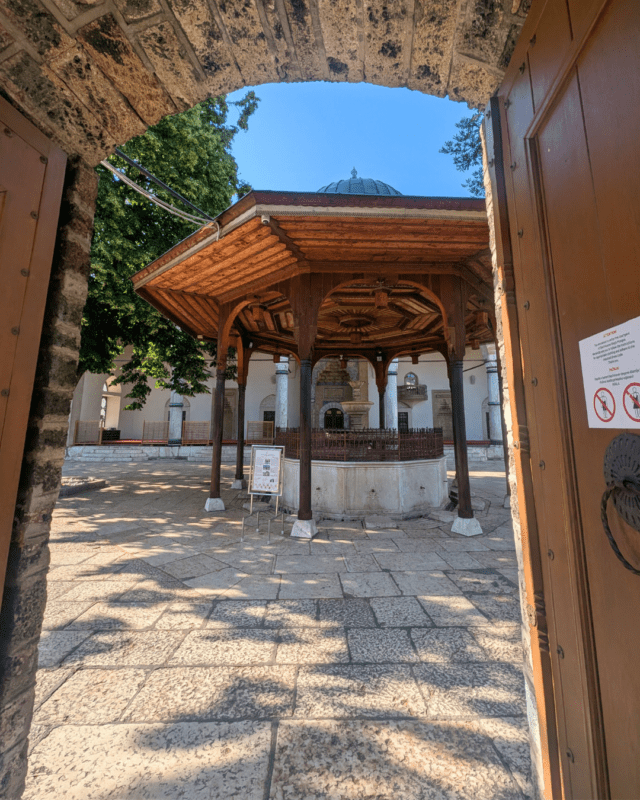
This mosque was built a few decades after the Ottomans established Sarajevo, from 1530-31.
The mosque itself wouldn’t look out of place in Turkey; it has a large dome and is surrounded by minarets. In the middle of the courtyard, there’s an ablution fountain.
You can go inside the Gazi Husrev-beg mosque, but like any mosque in the Islamic world, you’ll need to be modestly dressed. I was wearing a strappy top (which is fine to wear in Sarajevo generally), so observed from outside. I’d also recommend carrying a light headscarf if you want to go inside!
The Meeting of Cultures Line
Although I’ve been to lots of cities that have been constructed by many different cultures and groups, Sarajevo is by far the most contrasting change between city areas!
There’s a literal line – the Meeting of Cultures Line – which marks the Ottoman/ Austro-Hungarian architectural boundary. Stand looking east, and the buildings and streets are decidedly Ottoman – turn around, and the buildings suddenly seem Central European.
When the Austro Hungarians took over at the end of the 19th century, rather than destroying the city (they were quite keen on having different cultures and architectures in their empire) they just added to it.
Museum of Crimes Against Humanity and Genocide
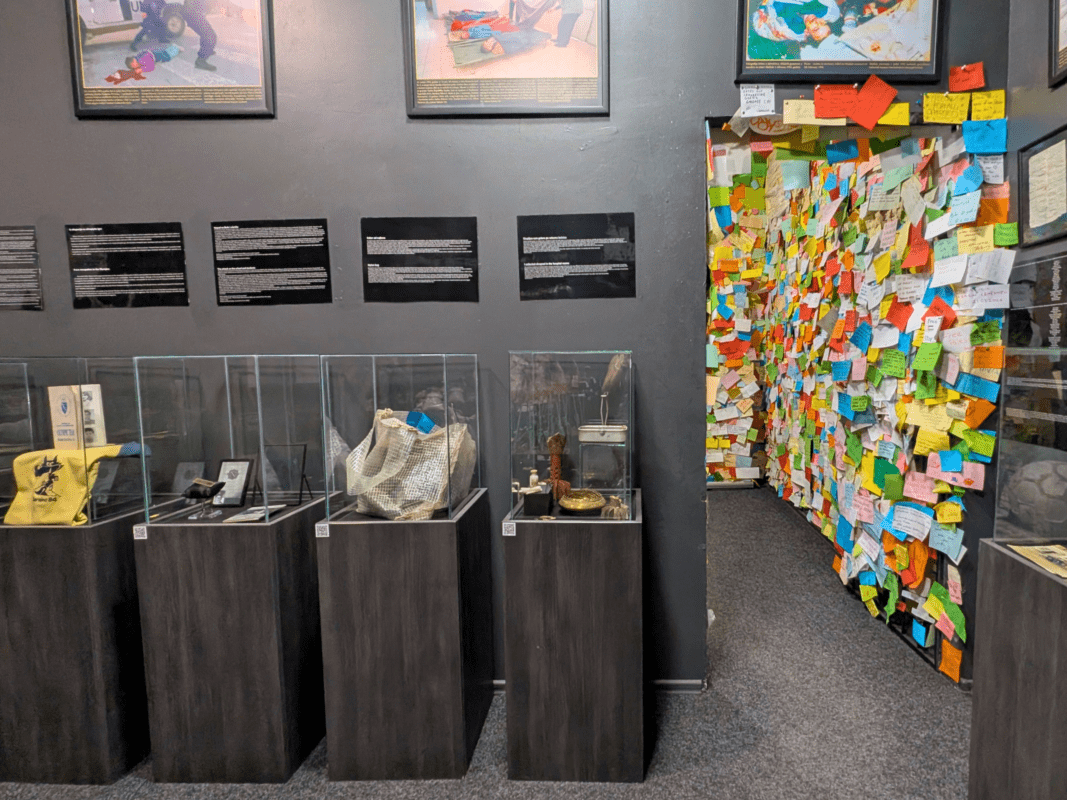
Sitting close to the Cathedral of the Sacred Heart, this museum covers the most sordid parts of the Bosnian War, including what daily life was like during the siege of Sarajevo and the genocide in Srebrenica.
I visited on my first morning in Sarajevo to get to know the history a bit more, and I’m really glad I did. It gave me more of a depth of understanding as I walked around.
Cathedral of the Sacred Heart
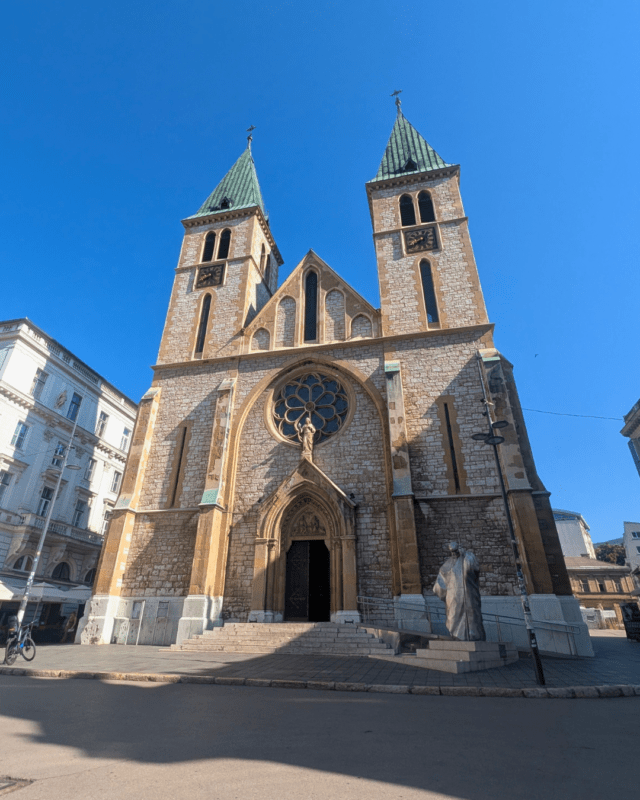
I walked past the Meeting of Cultures line, admiring the suddenly-tall Central European style houses, and made my way to the Cathedral of the Sacred Heart.
Built from 1884 – 1887, this cathedral was apparently for the Catholic population – although there weren’t many in the city until the Austro-Hungarians appeared. It’s a Neo Gothic Cathedral with some Romanesque Revival elements. It was modelled after the Notre Dame in Dijon in France.
The element I found the most interesting was the tall windows, which were apparently modelled to move your eyes upwards, closer to god!
You can go inside the Cathedral of the Sacred Heart; there was an event when I was there, however, so I didn’t pop in!
Latin Bridge
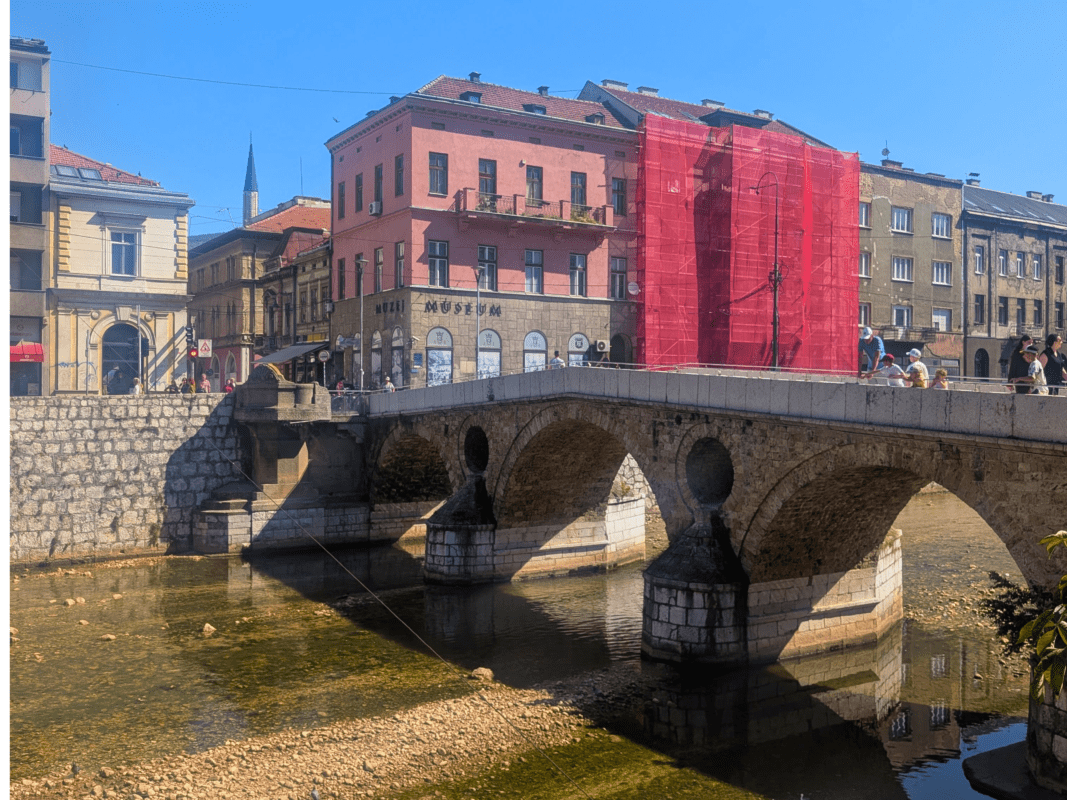
Latin Bridge doesn’t seem that remarkable – other than being a pretty, historic bridge – but it was here where World War One began.
In 1914, Archduke Franz Ferdinand was assassinated as his car turned onto this bridge. There had actually been an assassination attempt on him earlier in the day, which had failed, but a man named Gavrilo Princip, who was part of the group fighting against Austro-Hungarian influence in the region, saw his car and thus a second opportunity to assassinate him.
The aim of the assasination was to end Austro-Hungarian dominance in Bosnia and Herzegovina, but it ended up causing a ripple effect that began WW1.
Sarajevo Museum
The Sarajevo Museum sits right at the corner where Archduke Franz Ferdinand was shot. There’s a replica of the car he was in outside, and inside offers a “VR experience” of the shooting – which sounds a little grim!
Sarajevo City Hall
Facing the river, the Sarajevo City Hall (Vijećnica) was constructed during the Austro-Hungarian period. The rulers wanted to pay homage to Sarajevo’s architecture style, but do something a bit different to the Ottoman buildings already in the city.
This Moorish-revival building was the answer! The architect (Karel Pařík) took inspiration from Morocco and Andalucia, creating a building that wouldn’t look out of place in Marrakech! It was first designed in 1891 and opened to the public in 1896.
During the siege, it was acting as the city’s library. Devastatingly, it was burned and severely damaged, but has since been rebuilt.
Markale Market
This market remains a popular spot to purchase vegetables, but during the early 1990s, it was the site of two devastating mortar attacks.
It’s a bit of a sombre attraction, but after reading about it in The Cellist of Sarajevo, I wanted to see it for myself, with the hope it would help me understand the siege a bit more.
At the time, it was one of the only places in the city where people could purchase food, and for the first two years of the siege, was considered relatively safe. But this all changed with the attacks; there was one in 1994, killing 68 people and one in 1995, which ended 43 people’s lives. Some historians have called the 1995 attack a turning point in the war.
Nowadays, it’s once again a busy market, popular with locals and a bit of a living metaphor for how life has had to go on since the horrific days of the siege.
Eternal Flame
Sarajevo has an Eternal Flame, which burns in memory of those who perished in the city in WW2.
The city was under Nazi occupation from 1941 to 1945 – four years exactly, to the day (the occupation started and ended on April 6th).
The Balkans had a large Sephardic Jewish population, whose ancestors had moved there during the Spanish inquisition and other violence towards Jewish people throughout Europe.. Ottomans were fairly religiously liberal and were happy for Jewish, Christians and Muslims to coexist (although non-Muslims paid higher taxes).
There were around 12,000 Jewish people in Sarajevo on the eve of World War Two, and an estimated 9,000 perished in the Holocaust.
You can visit the Eternal Flame, although when I was there in June 2026, it had scaffolding surrounding it. Please drop me a message if you’ve managed to visit it and the scaffolding has been removed.
Dariva Path
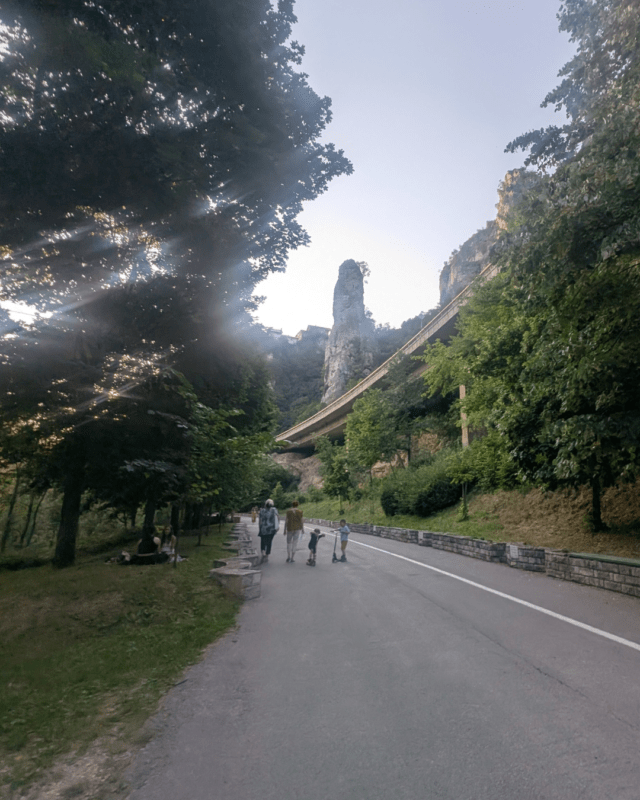
This path made me love Sarajevo! It’s the city’s oldest walking path and spans 8km along the Miljacka Canyon. Starting just a 10 minute walk from the Old Town, it follows the river and gorge.
I only found it because I’d asked a guide where to run in the area, and it quickly turned into my favourite spot in Sarajevo – I couldn’t believe how close it was to my hotel! I visited during the evening for a 10km run. Lots of locals were cycling and rock climbing, and there were a few other runners too!
Yellow Fortress
Unfortunately, I didn’t have time to visit the Yellow Fortress – I was going to go on my run but was enjoying Dariva too much!
It’s an 18th century Ottoman fortress, built around 1730 and is widely thought to be the best sunset spot in the city.
Where to stay in Sarajevo
I stayed in Hotel Halvat, which was my favourite place I stayed at in all of the Balkans. It felt like the best bits of a boutique hotel and friendly B&B – lovely staff, rooms with all the mod cons and it was in a fantastic location.
The bed was so comfy (and I have a mattress made by one of the most famous UK sleep specialists, so I’m a harsh critic!) and AC was much needed after a sweaty day exploring Sarajevo.
Click here to read more about it.
The only thing to note is that payment is cash only. I highly recommend bringing Euros to Sarajevo (and Bosnia and Herzegovina in general) – they’re accepted everywhere at a rate of one Euro to every two BAM, and ATM fees can be high.
Where to Eat/Drink
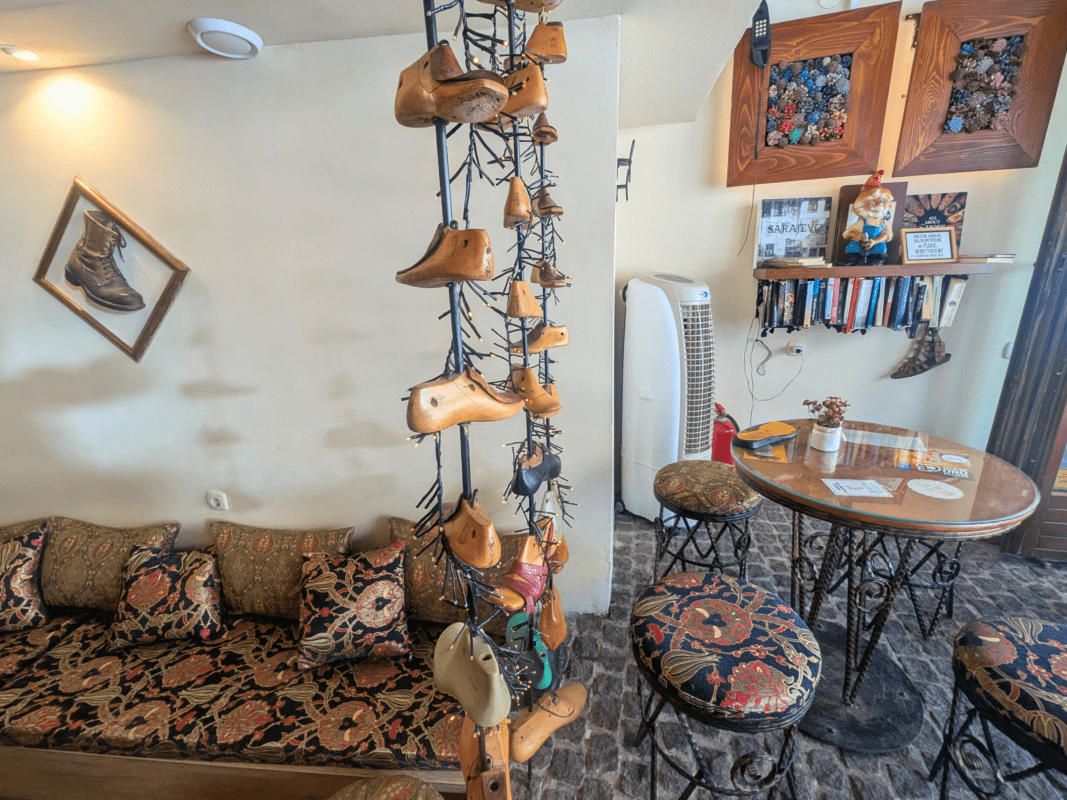
Although I didn’t try any typical Bosnian food (being veggie makes it difficult sometimes!), I found some nice eateries and coffee stops in Sarajevo.
- Fabrika Coffee – serves up soy cappuccinos and other coffees, including Bosnian coffee
- Ministry of Ćejf – has a few locations including by the old city. Serves a range of coffees from Bosnian to cappuccinos, with plant milk. Has a really quirkily decorated interior!
- Caffe Bar Andar – a shoe makers shop turned cafe! Again, it has a range of coffees. I tried Bosnian coffee here – I’m glad I tried it, but it wasn’t my favourite!
- Abu Zadallah – there are quite a lot of Arabic restaurants in the city, due to the increase in Gulf tourism to Sarajevo (there are direct WizzAir flights to Dubai!). I fancied falafel,so found Abu Zadallah. It wasn’t as good as I’ve had in Lebanon, but I still very much enjoyed it!
- Slastičarna Tip-Top – this is a lovely local ice cream shop right in the heart of the city centre!
I did struggle to find a grab-and-go breakfast in Sarajevo, so I’d recommend choosing a hotel that serves breakfast or grabbing some stuff from the supermarket.
Hotel Halvat serves breakfast, but its an extra cost of nine euros.
Where Next
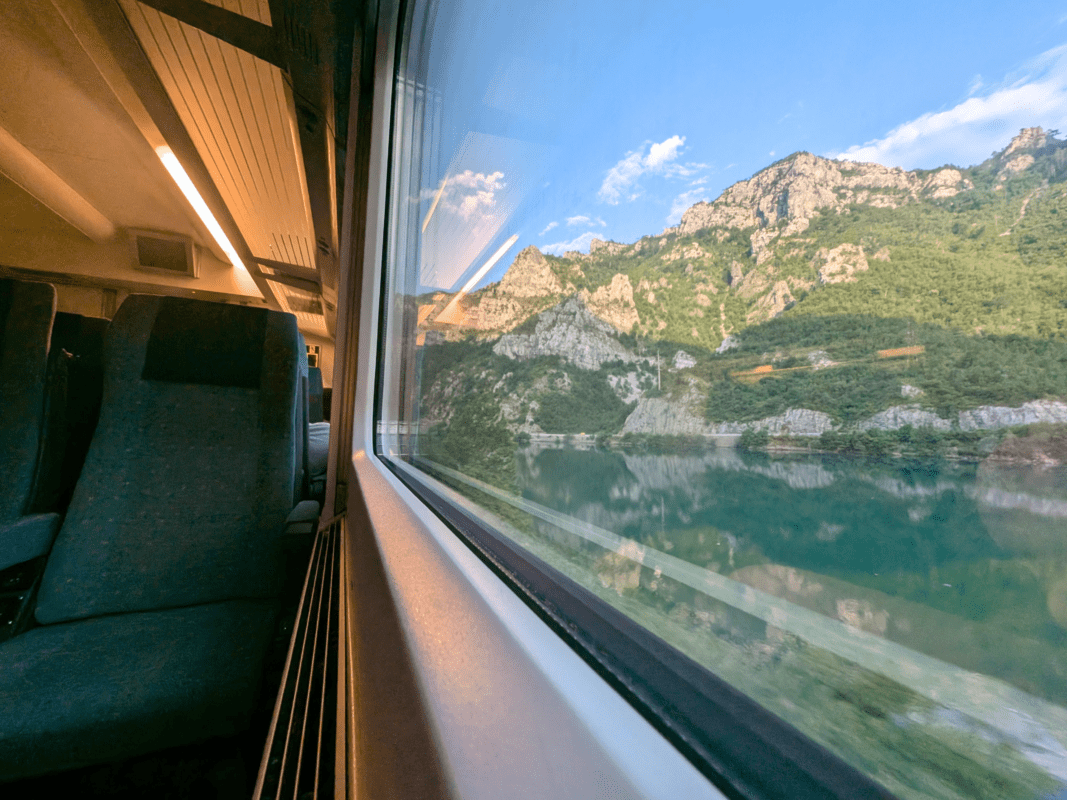
I took the train to Mostar after – it’s a two hour journey through some of Bosnia’s most beautiful scenery! There will be a post about that soon, but in the meantime take a look at my other Balkans posts!
- 10 things to do in Pristina: what I did in 24 hours
- Montenegro to Kosovo by bus: how to take it in 2026
- How to take the Belgrade to Bar train (Serbia to Montenegro)
- How to take the Pristina to Peja train (Kosovo’s last railway)
- Is Bosnia expensive? Everything I spent in 3 days
