

I travelled from Amsterdam to Zurich on a 12-hour overnight bus with business-class seats that convert into fully flat beds!
The service is run by Swiss company Twiliner and is described as Europe’s first night bus with lie-flat seats. Its network connects cities including Amsterdam, Rotterdam, Brussels, Luxembourg, Basel and Zurich. A second route runs between Switzerland and Barcelona via Girona.
I normally sleep well on night trains, but my previous experiences of overnight buses have involved standard reclining seats and very little sleep! I wanted to find out whether a flat bed could make travelling overnight by bus a feasible alternative – here’s what I thought!
Boarding the Twiliner bus in Amsterdam
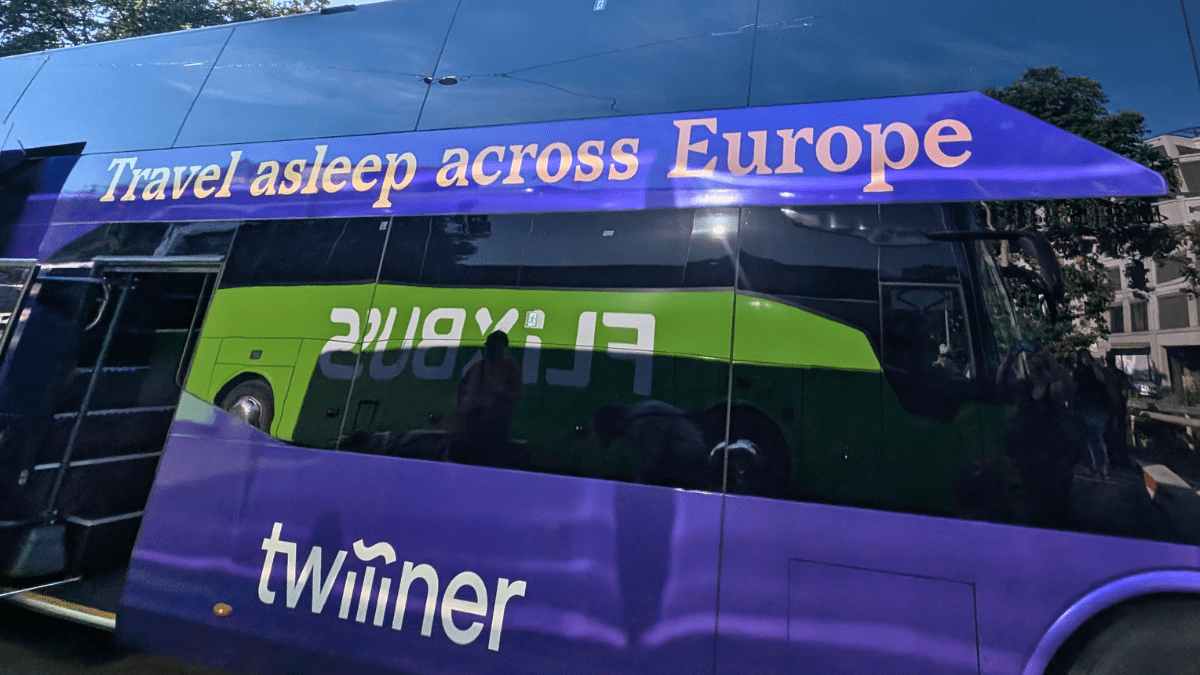
My journey started at Amsterdam Sloterdijk, one of the city’s main bus and railway stations. International buses leave from the bus stops outside the station (where the Flixbus coaches also leave from).
Twiliner arrived around five minutes before departure. Boarding was quick – I handed over my luggage, found my allocated seat and was ready to leave within minutes!
The bus has two levels. Most of the passenger seats are upstairs, while the toilet, changing room, snack bar and a small number of additional seats are downstairs. There were also two members of staff on board, including the driver.
Shortly after departure, we received an announcement explaining where everything was located. The bus then left Amsterdam and headed south towards Rotterdam, Brussels and Luxembourg before continuing overnight to Basel and Zurich.
My bus was quiet, but the seats are large and comfortable which means that there are naturally far fewer people on board even when it’s full.
What are the Twiliner seats like?
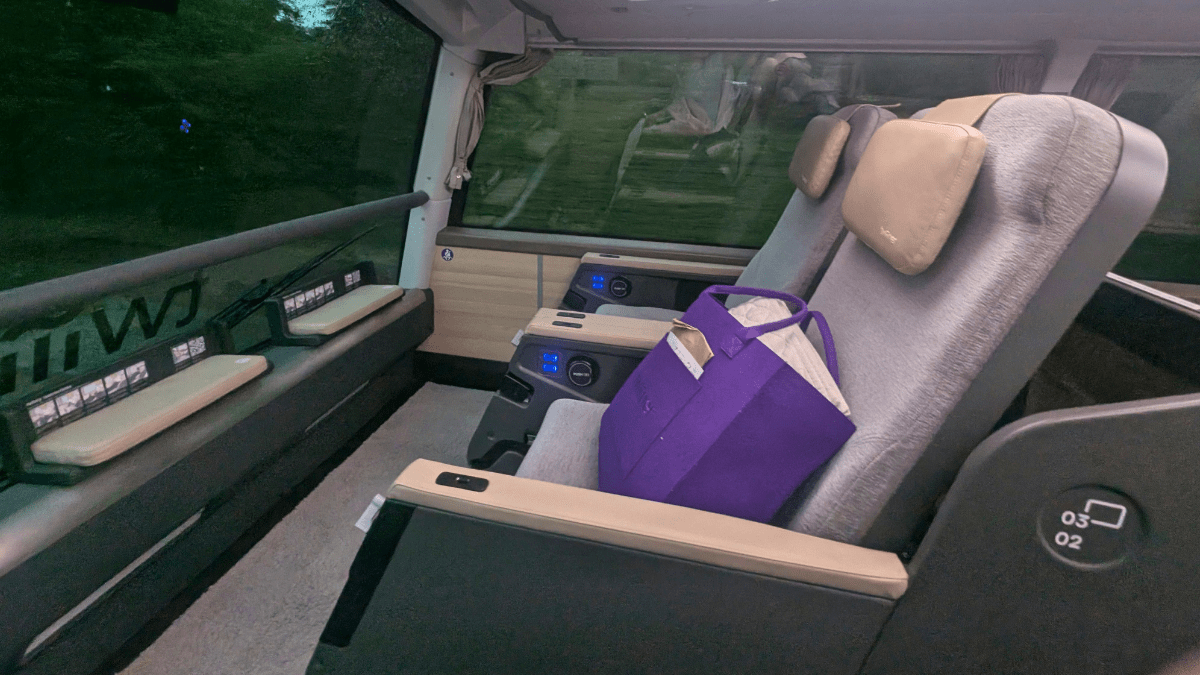
The seats are arranged in a 2+1 configuration. There are pairs of seats on one side of the aisle and individual seats on the other, which you can book if you are travelling alone and want your own space. Seat selection is free when booking.
I had a single seat at the front of the bus. It felt more like a business-class airline seat than anything I had previously encountered on a coach!
Each seat has a solid tray table large enough for a laptop, along with USB, USB-C and standard power outlets. The bus also has free unlimited Wi-Fi. I connected shortly after leaving Amsterdam and didn’t encounter the restrictive data limits you sometimes find on trains and coaches.
I found ventilation controls above the seats (the attendant also said to tell him if it was too hot or too cold ad he’d adjust the heating), while buttons beside the armrest control the recline. You initially press the standard recline button before using a separate lie-flat setting to lower the seat into its sleeping position.
Every passenger receives a bag containing bedding. Mine included a pillow, pillowcase, sheet and duvet. Free earplugs were also available downstairs. You can also buy an eye mask, but I had brought my own.
The bed is narrower than a hotel bed and you can still feel that you are on a moving vehicle. However, being able to lie horizontally makes an enormous difference compared with trying to sleep in a conventional coach seat!
The seats also incorporate a safety restraint designed for the lie-flat position. You keep your seat belt fastened and place your feet inside a secured fabric compartment, which helps prevent you from sliding forwards if the driver brakes suddenly.
The snack bar, changing room and toilet
The lower floor contains several features that I had never seen together on an overnight bus.
The snack bar has drinks and food that you can purchase by scanning a QR code. Free tea and coffee are available from a separate machine. A small selection of toiletries is available if you have forgotten something.
Next to the snack bar is a separate changing and washroom It has a seat, sink, bin, mirror (with mood lighting!), soap and lotion. The toilet, also with a sink, is next door.
Turning my seat into a fully flat bed
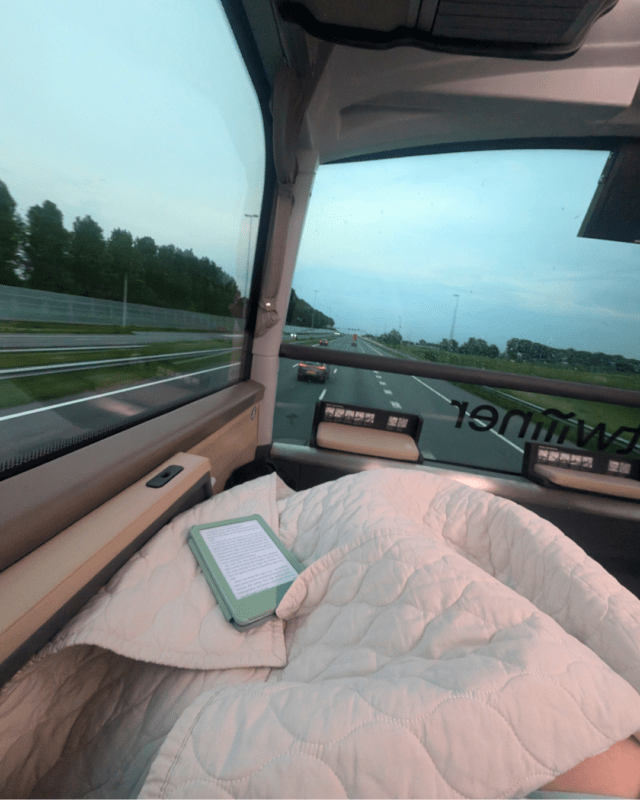
Once I was ready for bed, it was time to get it set up!
I first reclined the seat as far as it would go using the standard control. Then, I pressed the lie-flat button, which lowered the remaining sections until the seat had turned ito a bed!
I added the pillowcase, spread the sheet across the seat and popped the duvet on top. I then connected the safety restraint, fastened my seat belt and put my feet inside the secured compartment.
The lights remained on during the evening stops, but turned off at around 10pm.
Why take the sleeper bus instead of flying?
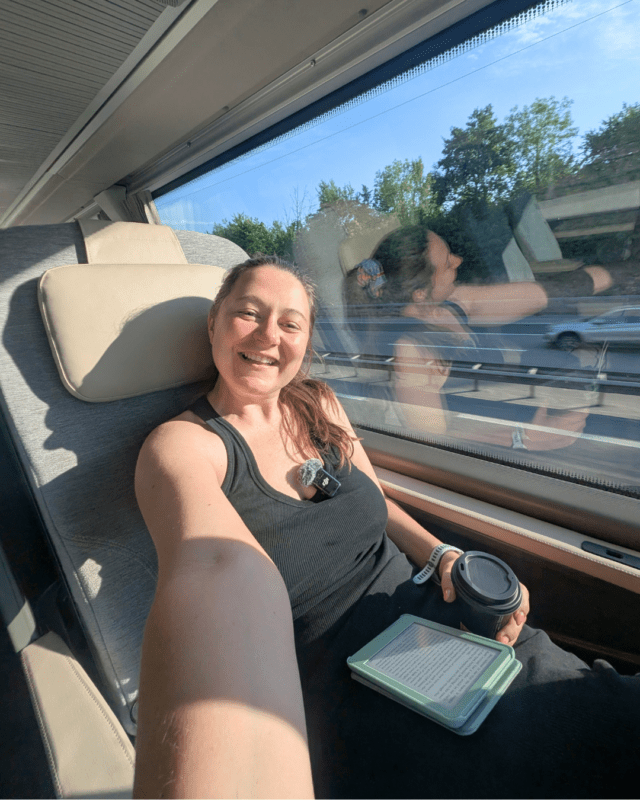
Whenever I share an overland journey, someone always asks why I didn’t fly. For me, travelling overnight is often more enjoyable than spending the same journey moving between airports!
The Twiliner leaves from within the city and arrives at a central destination the following morning. You don’t need to travel to an out-of-town airport, arrive well ahead of departure, go through security or wait at a baggage carousel after landing.
The journey also replaces a night in a hotel. I could spend the day in Amsterdam, board the bus that evening and wake up in Switzerland, spending the whole day in Zurich!
Of course, this only works if you can sleep; a cheap overnight bus that leaves you exhausted may save the cost of a hotel, but you could lose much of the next day recovering! This is where the fact that it’s a lie-flat bus helps a lot!
There is also an environmental benefit. Twiliner states that its journeys generate up to 91% less CO₂ per passenger kilometre than flying. According to the company’s calculations, you could make the equivalent bus journey ten times before matching the emissions from one flight. Twiliner explains its onboard facilities and emissions figures on its website.
How well did I sleep on the Twiliner?
I woke up several times during the night, including a couple of trips downstairs to use the toilet; but that’s very normal for me.
I occasionally felt turns or changes in the road surface, but nothing that kept me awake dramatically; generally, I felt like I slept well.
One of Twiliner’s USPs is that there are no late-night stops where large numbers of passengers board or leave the bus. As it drives through Schengen countries, there’s also no passport control!
The only room for improvement was that there was a small dip between sections of the seat, which would probably be less noticeable if you sleep on your back. I sleep on my side, so it took me a while to find the right position! But I eventually did, and I slept considerably better than I have on any conventional overnight bus.
I woke after Basel with around 45 minutes remaining before Zurich. By that point, I could have happily slept for several more hours!
I went downstairs to freshen up and get a coffee before returning to my seat to pack away the bedding.
For sleep alone, I would rate the experience 8/10. Compared with sleeping on public transport generally, I would give it 9.5/10. The bed was comfortable enough for me to arrive in Zurich ready to go for a run, find some coffee and spend the afternoon by the lake!
My honest Twiliner review
Twiliner has solved the main problem with conventional overnight buses: trying to sleep while sitting almost upright.
The lie-flat seat, bedding, individual power outlets and separate changing room made the journey feel closer to business-class travel than a standard coach service. Free Wi-Fi meant I could work before bed, while the tea and coffee station woke me up in Switzerland!
I would recommend packing an eye mask and earplugs, but the sleep was comparable to a spacious night train. I’d definitely book it again!
Twiliner currently serves destinations including Amsterdam, Rotterdam, Brussels, Luxembourg, Basel, Zurich, Bern, Girona and Barcelona. Routes and departure days can change (they’re hoping to launch more in the next few years!), so check the current timetable before planning the rest of your trip.
